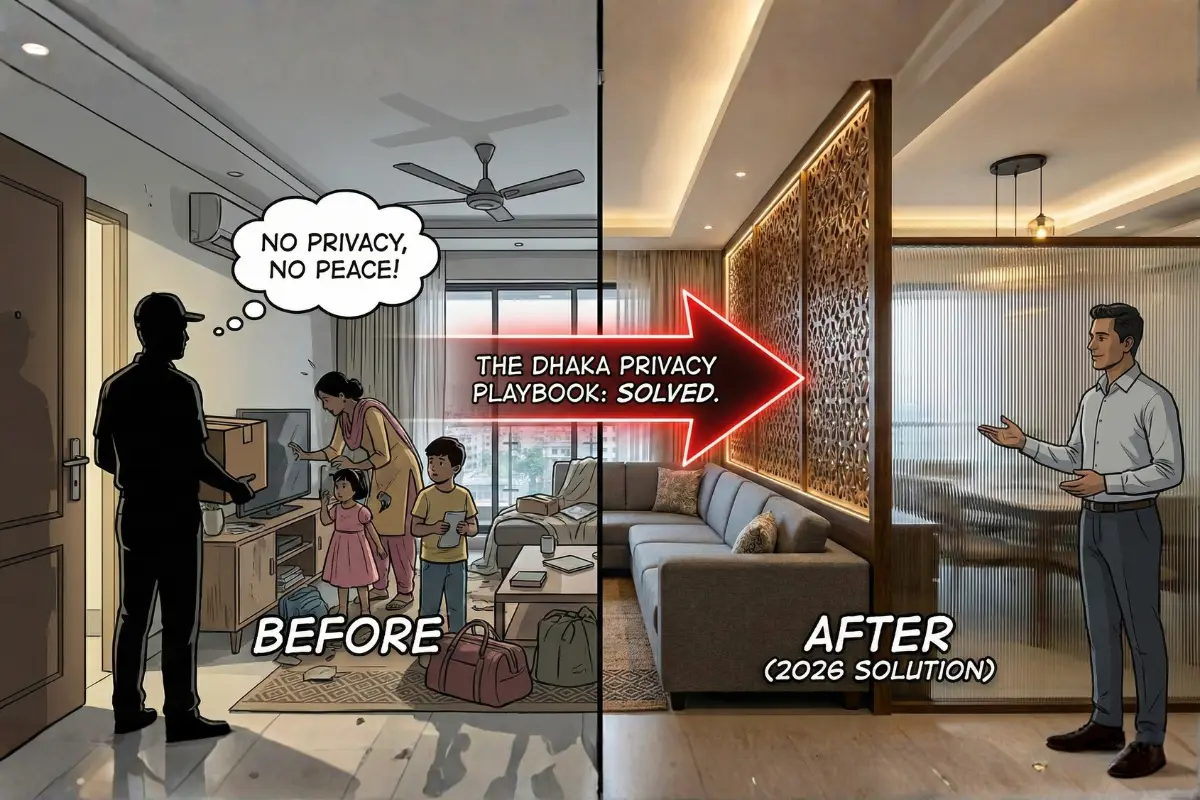
Privacy is the soul of a Bangladeshi drawing room. In our culture, the home is a sanctuary, and the drawing room is often the first and only room a visitor sees is the gatekeeper of that sanctuary. By 2026, the trend has shifted from heavy, permanent walls to “soft barriers” like CNC jali, glass screens, and console partitions that allow for breathability without compromising the family’s seclusion.
A successful drawing room interior design balances the aesthetic demand for a “showcase” with the practical need for family privacy, especially in the densely packed apartments of Dhaka. Whether you are designing a luxury duplex in Gulshan or a compact flat in Mirpur, the goal remains the same: presenting your best self while shielding your private life.
Market Insight 2026: Prices for standard interiors in the capital now start at about ৳1,000 per square foot, while premium projects utilizing high-end veneer, Chittagong Teak, and charcoal louvers can push costs to ৳3,000 or more per square foot.
Have you ever noticed the sudden silence that falls over a Dhaka household when the doorbell rings? The kids scramble to their rooms. The kitchen door slams shut. Someone frantically looks for a dupatta. This is the classic Bangladeshi hosting ritual, a beautiful but complex dance of hospitality and privacy.
In our society, the drawing room is a stage. It is where we honor our guests with the best tea, the most comfortable seating, and the most sophisticated decor. However, modern architecture in areas like Banasree, Uttara, or Bashundhara has created a problem. Apartments are getting narrower, and poor planning often places the main entrance right in the center of the home.
Designing a drawing room interior design that feels expansive and expensive while ensuring a stranger at the door can’t see your kitchen or bedroom is the ultimate challenge for 2026.
The drawing room is uniquely challenging because it must fulfill two conflicting roles: it is a high-end public showcase and a private barrier. Many people assume that living room interior design and drawing room design are identical, but they are not.
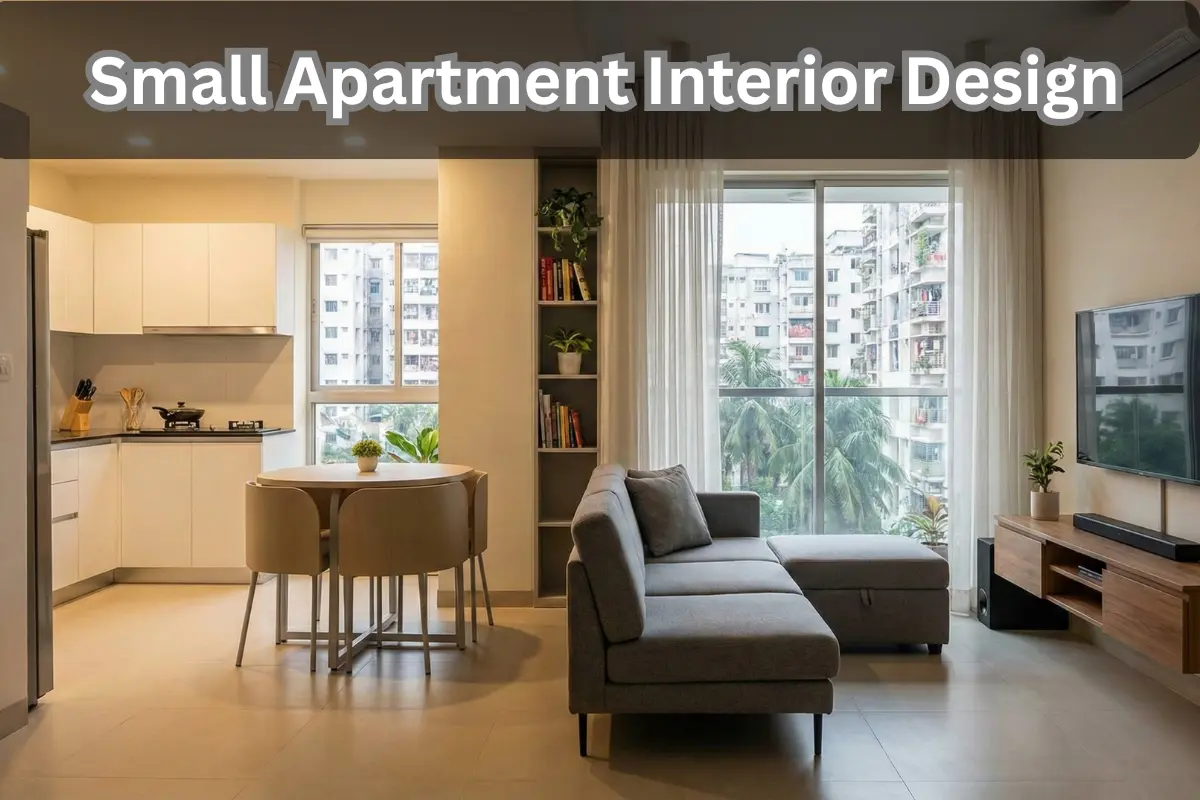
When you are working with a small drawing room, the pressure is even higher. You are forced to fit a massive sofa set, a sophisticated TV unit, and often a dining table into a single rectangular space. Without a professional “Privacy Playbook,” the room ends up feeling like a chaotic hallway rather than an inviting lounge.
For narrow drawing rooms, the main goal is to avoid the “railway carriage” effect, where furniture is lined up against the walls in a long, monotonous row. This layout makes the room feel cramped and removes any sense of design authority.
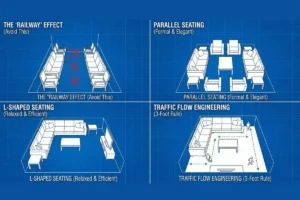
The sofa layout you choose dictates the entire “vibe” of the room:
If a guest has to shift their legs every time your child goes from the bedroom to the kitchen, your drawing room interior design has failed. Professional designers in Dhaka now follow the 3-foot rule: always leave at least 3 feet of clear walking space behind or to the side of the main seating area. This simple “Traffic Flow Engineering” ensures that the “social zone” remains uninterrupted by the house’s daily “traffic zone”.
In 2026, the era of building a solid brick wall in the middle of a flat is over. It blocks sunlight, kills airflow, and makes a 1,200 sqft flat feel like a 600 sqft cave. Instead, we use “soft shells” to create a dining room partition.
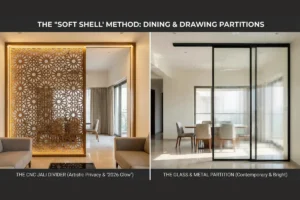
A CNC jali partition made from high-density HDF or veneer board offers a breathable, artistic way to hide the dining area.
For a more contemporary look, fluted glass partitions with black aluminum or golden SS (Stainless Steel) frames are a top trend. The fluted texture distorts the view (providing privacy) while allowing 100% of the light to pass through, keeping the home bright and airy.
In a Bangladeshi household, the TV is the hearth. Even when it’s off, the TV cabinet interior design dominates the visual landscape of the room.
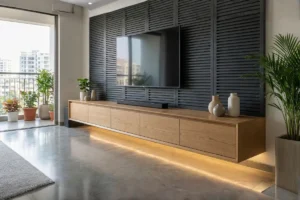
Floors in Dhaka are notorious for dust. A floor-standing unit creates a “dark zone” where dust bunnies thrive. By 2026, professional designers exclusively recommend floating TV units installed 8 to 10 inches off the ground. Not only is this easier to clean, but it also creates the illusion of more floor space, making the room feel significantly larger.
Nothing ruins a wall interior design faster than a cluster of black power cables hanging like vines. The 2026 solution is the “Double Wall” back panel. We build a slim panel (using charcoal louvers or veneer) about 2 inches in front of the actual wall. All wires for the TV, soundbar, and Wi-Fi router are routed through this hidden gap, resulting in a clean, “magazine-perfect” look.
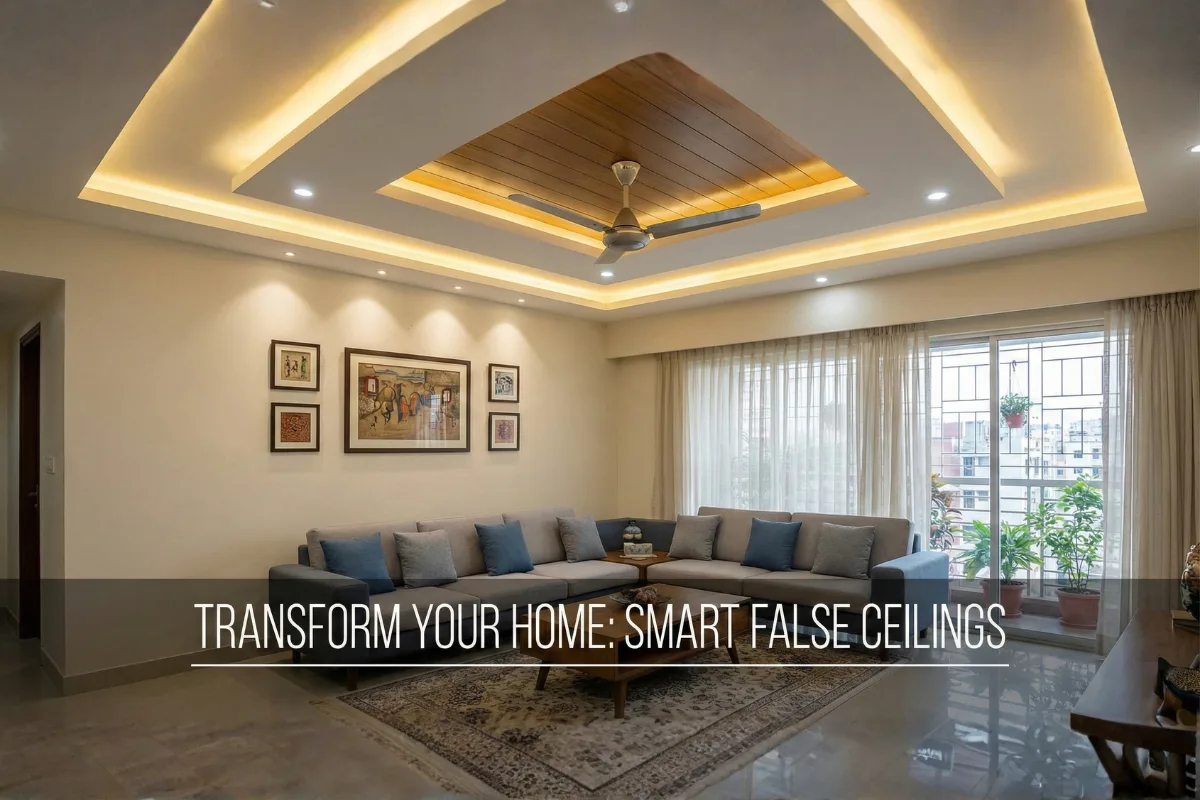
Lighting is the difference between a cold hospital room and a warm, luxurious lounge. You can spend 10 Lakh Taka on a sofa, but if you rely on a single white tube light, the room will look cheap.
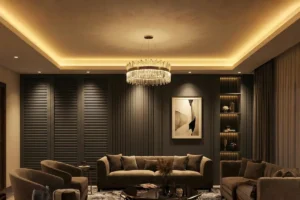
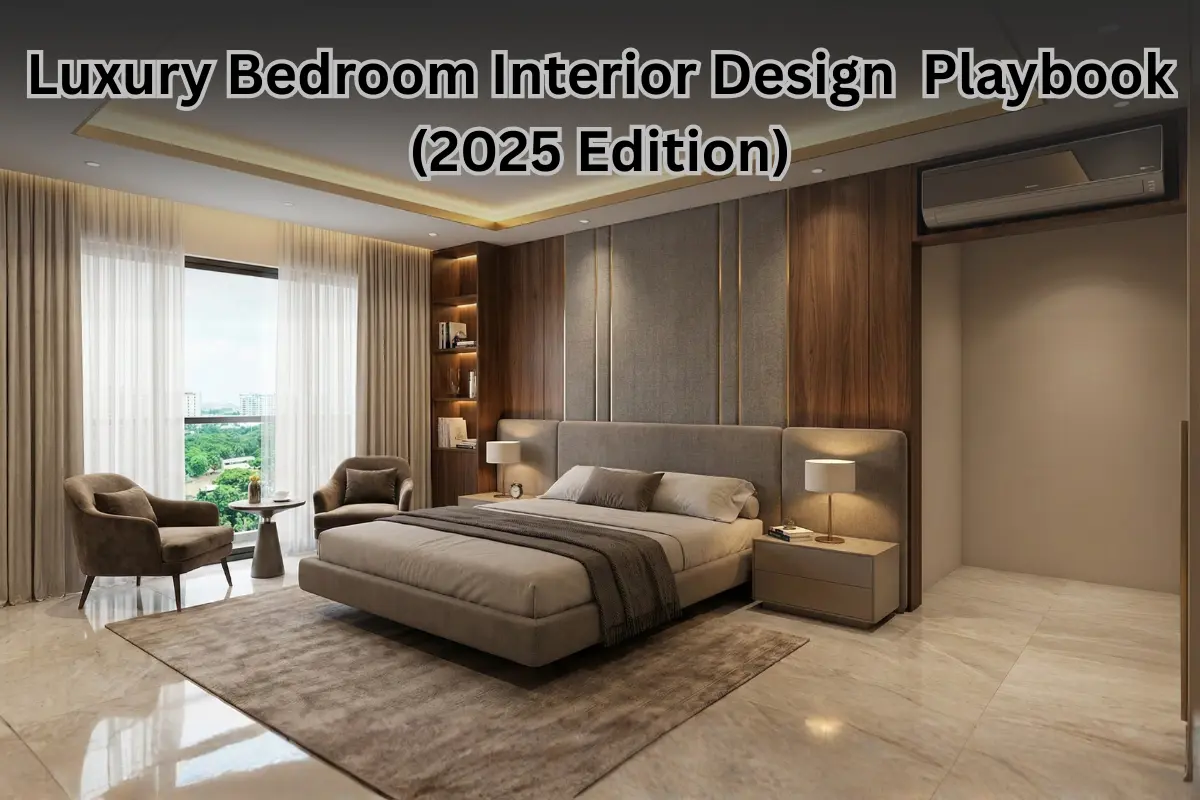
Smooth, white walls are a thing of the past. In 2026, wall interior design is all about texture. Charcoal louvers and fluted panels are moisture-resistant (essential for Dhaka’s humidity) and add vertical lines that make the ceiling feel taller. When you place a warm spotlight above these panels, the shadows create a three-dimensional, sophisticated environment.
A formal drawing room needs three layers of light:
Bangladesh’s climate high humidity and high dust requires specific material expertise.
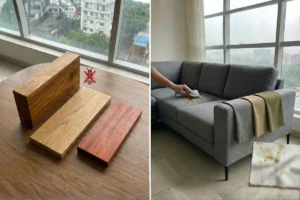
For longevity and status, Chittagong Teak (Segun) remains the undisputed king. It is naturally resistant to termites and warping. For a more modern, lighter look, Oak or Mahogany are excellent secondary choices.
Avoid white or cream sofas in Dhaka unless you enjoy constant cleaning. The 2026 playbook recommends Performance Fabrics in Grey, Tan, or Olive Green. These colors mask dust effectively and can be wiped down with a damp cloth without staining.
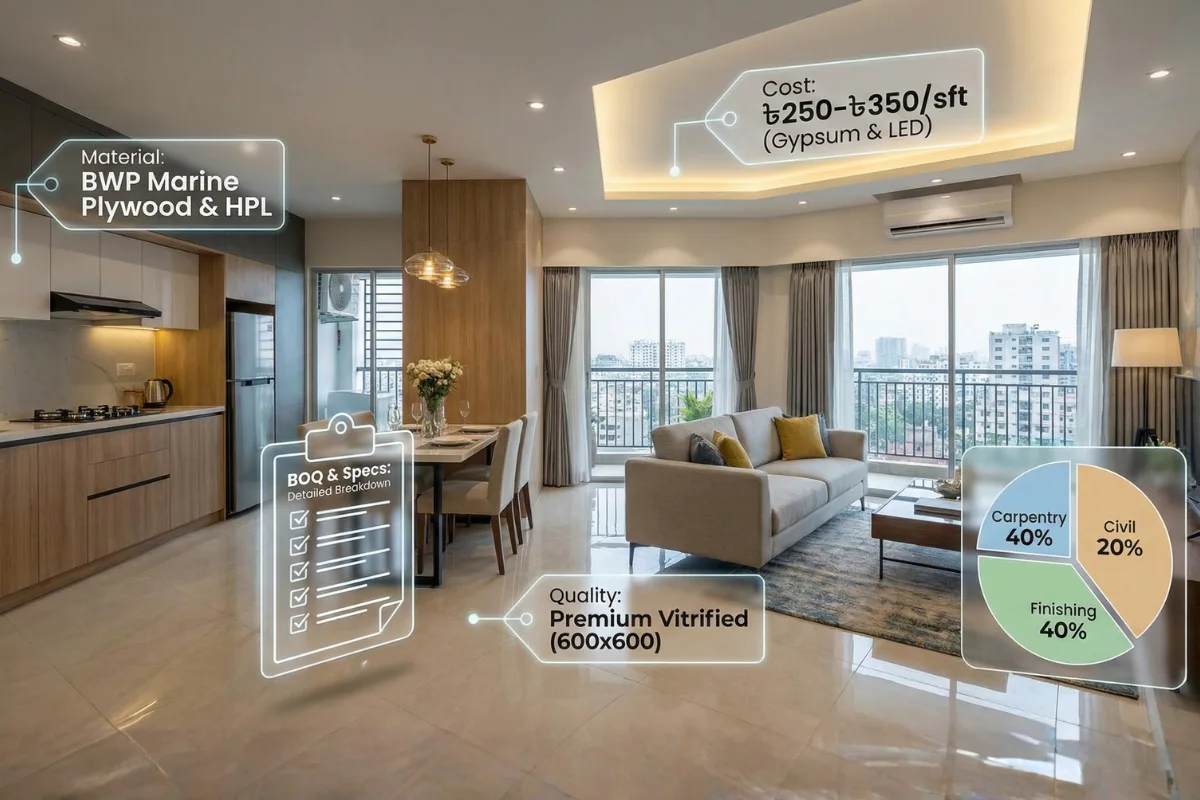
| Tier | Materials Used | Estimated Cost (Dhaka 2026) |
| Budget | Melamine board, plastic paint, local furniture | ৳80,000 – ৳1,50,000 |
| Standard | HDF, CNC jali, custom sofa, false ceiling | ৳2,00,000 – ৳5,00,000 |
| Luxury | CTG Teak, veneer, charcoal louvers, PU lacquer | ৳6,00,000 – ৳12,00,000+ |
The biggest cost drivers are the sofa set and the level of wall paneling. For middle-class homeowners, focusing your budget on a single “feature wall” and a high-quality sofa is the most efficient way to achieve a premium look without overspending.
The perfect Drawing room interior design is not defined by its price tag, but by its intelligence. A room that respects your family’s privacy, manages the dust of Dhaka, and welcomes your guests with warm, atmospheric light is a successful home.
Whether you are browsing drawing room interior design pictures for inspiration or planning a full-scale renovation, remember that the best layout is the one that lets your family breathe, and your guests feel honored. Staying informed about materials and costs is the first step toward a home you can be proud of.
Use mirrors on one wall to double the visual space, install floor-to-ceiling curtains to make the room look taller, and replace harsh overhead lights with warm cove lighting.
Chittagong Teak (Segun) is the gold standard for durability and beauty. For a modern look, Mahogany or Oak are excellent, while high-density Veneer Board is a great budget alternative.
In our humid climate, high-quality paint or charcoal louvers are usually better. Wallpaper tends to peel due to dampness, whereas charcoal panels are moisture-resistant and last much longer.